

Choosing a great steak is not about picking the most expensive cut in the display. It is about matching the cut to the way you plan to cook it and the eating experience you actually enjoy.
Different types of steak vary in tenderness, marbling, beef flavor, thickness, bone content and cooking difficulty. A Ribeye may be ideal for someone who enjoys rich flavor and visible marbling, while Tenderloin makes more sense when tenderness is the main priority. A Tomahawk, on the other hand, is often selected as much for the cooking and serving experience as for the steak itself.
The simplest rule is this:
The best steak cut depends on your cooking method and personal preference—not on the name alone.
Quick answer: Choose Ribeye for rich flavor and marbling, Tenderloin for tenderness, T-Bone for a bone-in steak experience, and Tomahawk when presentation and sharing matter. Do not let the name or price decide everything; match the cut to your cooking method and experience level.
This guide compares the most popular steak cuts, explains how to select steak for grilling or pan searing, answers why prices differ and gives you a one-minute decision tool to find the right cut.
What Is Steak, and Why Do Steak Cuts Differ?
Steak is not a separate type of animal or meat. The term generally refers to meat cut into portions that are suitable for methods such as grilling, broiling or pan searing.
Many popular beef steak cuts come from the rib and loin areas, but each muscle has different characteristics.
The final eating experience can be affected by:
- Where the cut comes from.
- How much the muscle is used.
- Intramuscular fat or marbling.
- External fat.
- Whether the steak is bone-in or boneless.
- Steak thickness.
- The direction and method of cutting.
- The cooking technique.
Marbling refers to the small streaks or flecks of fat found within the muscle. A well-marbled steak can deliver a richer eating experience as the fat renders during cooking. That does not mean, however, that more fat automatically makes a steak better for every person.
Professional butcher guidance also recommends looking for consistent steak thickness because it helps promote more even cooking.
So instead of asking only, "What is the best steak?" it is more useful to ask:
What do I want my steak to taste and feel like?
Popular Types of Steak and Their Differences
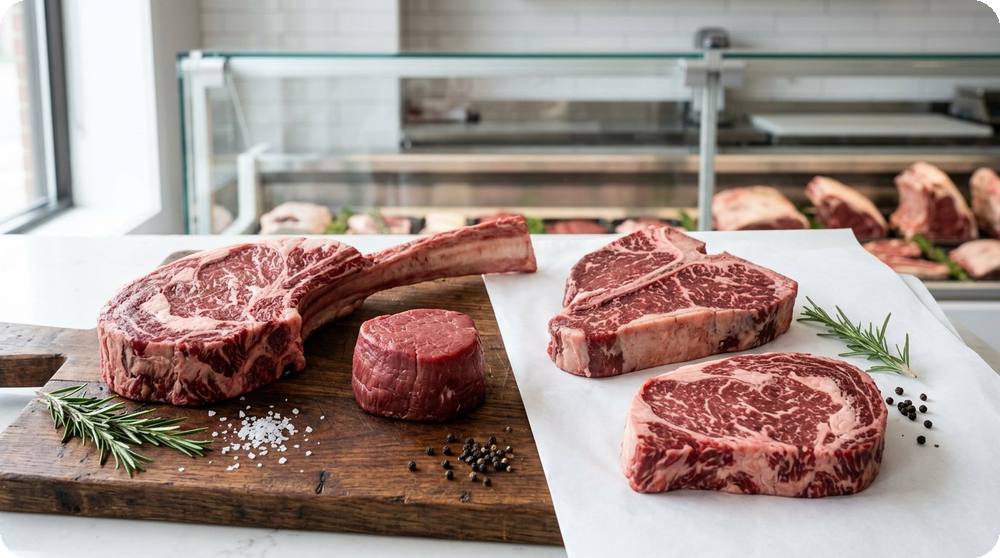
There are dozens of steak names around the world, and terminology can vary by country, butcher and retailer. The following cuts, however, are among the most useful to understand before buying a premium steak.
Ribeye Steak
Ribeye is one of the classic choices for people who want a rich, juicy steak.
It comes from the rib section and is known for marbling throughout the meat. The combination of tenderness and internal fat gives Ribeye its characteristic full flavor.
Ribeye is also widely suited to grilling and high-heat cooking. Beef grilling guidance lists Ribeye together with Strip, T-Bone and Porterhouse among popular rib and loin cuts for the grill.
Choose Ribeye if you:
- Prefer rich beef flavor.
- Enjoy marbling.
- Plan to use a grill or heavy skillet.
- Want a classic steakhouse-style experience.
- Are looking for a relatively forgiving premium steak.
Hummmy Yummmy offers Ribeye Steak as part of its steak range.
T-Bone Steak
T-Bone is immediately recognizable because of the T-shaped bone running through the steak.
More importantly, the bone separates two different sections of meat. That means a single T-Bone can offer slightly different textures on each side.
This is also what makes cooking it interesting. Because the two muscles do not necessarily cook identically, a T-Bone rewards better heat control than a simple, uniformly shaped boneless steak.
Choose T-Bone if you:
- Enjoy bone-in steaks.
- Want more than one texture in a single cut.
- Prefer grilling.
- Have some experience managing grill heat.
- Want a steak with a traditional, substantial presentation.
Hummmy Yummmy offers Fresh Local Veal T-Bone Steak, with the product page recommending it for grilling and direct-heat cooking.
Tenderloin Steak
If tenderness comes before everything else, Tenderloin deserves your attention.
The tenderloin is a relatively little-used muscle, contributing to its soft texture. In the 2021 National Beef Tenderness Survey, Tenderloin recorded the lowest Warner-Bratzler shear-force readings among the steak cuts evaluated, supporting its reputation for exceptional tenderness.
The trade-off is that Tenderloin generally relies less on heavy marbling for its eating experience than a Ribeye.
That is why comparing Tenderloin with Ribeye is not really a question of which one is "higher quality." They simply satisfy different preferences.
Choose Tenderloin if you:
- Want maximum tenderness.
- Prefer less visible fat.
- Enjoy a soft, fine texture.
- Cook with a pan or grill.
- Want a refined steak for a special dinner.
You can explore Local Veal Tenderloin Steak from Hummmy Yummmy.
Tomahawk Steak
Tomahawk is the steak people often notice before they even ask how it tastes.
A Tomahawk is essentially a rib steak with a long rib bone left attached. Specialist beef references describe it as a bone-in steak from the rib with an extended rib bone and the characteristic marbling associated with the cut.
Its large size and dramatic shape make it popular for sharing and special occasions.
But is Tomahawk worth the price?
That depends on what you value.
If your only target is maximum boneless meat for your budget, remember that some of the purchased weight belongs to the long bone.
If you value the experience of grilling a thick steak, slicing it at the table and serving it as a centerpiece, Tomahawk offers something that an individual steak does not.
Its thickness also makes heat control more important. Instead of leaving the steak over the hottest section of the grill from beginning to end, thick steaks often benefit from using both cooler and hotter cooking zones.
Choose Tomahawk if you:
- Are preparing a special meal.
- Want a steak for sharing.
- Enjoy the flavor profile of rib cuts.
- Have a grill with good temperature control.
- Care about presentation as well as taste.
Hummmy Yummmy lists a Chilled Grain-Fed Russian Black Angus Tomahawk, described for grilling or oven cooking.
Striploin and Strip Steak
Strip Steak—often associated with names such as New York Strip or cuts from the striploin—is a useful middle ground between tenderness and strong beef flavor.
It tends to have a firmer bite than Tenderloin while remaining one of the classic steaks for grilling.
For many steak lovers, that balance is exactly the appeal.
Choose Strip Steak if you:
- Want a balance of tenderness and beef flavor.
- Like a slightly firmer steak texture.
- Plan to cook over direct heat.
- Prefer less widespread marbling than a heavily marbled Ribeye.
Sirloin Steak
Sirloin and Striploin are sometimes confused in everyday conversation, but they should not automatically be treated as the same cut.
Top Sirloin in particular can be a smart option when value for money matters. Professional butcher guidance describes Top Sirloin as flavorful, reasonably tender and often more value-driven than some better-known premium steaks.
For someone buying steak for the first time, that can make Sirloin worth considering before automatically jumping to the most expensive option available.
Quick Steak Cut Comparison
| Steak cut | Tenderness | Flavor | Marbling | Best for | Experience |
| Ribeye | High | Rich | Higher | Grill, skillet | Beginner–Intermediate |
| T-Bone | High but varied | Rich | Medium | Grilling | Intermediate |
| Tenderloin | Very high | Mild to medium | Lower | Skillet, grill | Beginner with careful timing |
| Tomahawk | High | Rich | Higher | Grill, two-zone cooking | Intermediate–Advanced |
| Striploin | Good to high | Beef-forward | Medium | Grill, skillet | Beginner–Intermediate |
| Top Sirloin | Good | Beef-forward | Low to medium | Grill, skillet | Beginner |
The table is not a ranking.
Someone who values marbling will probably choose differently from someone who wants the softest, leaner-feeling steak possible.
Ribeye vs T-Bone: Which Is Better?
This is one of the most common comparisons when shoppers investigate different types of steak for grilling.
Ribeye focuses the experience on rib flavor and marbling. It is rich, juicy and particularly well suited to people who enjoy visible intramuscular fat.
T-Bone offers something different: the bone divides two sections of steak, producing variation in texture and presentation.
A simple decision rule is:
Choose Ribeye for:
Rich flavor + marbling + a classic grill-friendly steak.
Choose T-Bone for:
Bone-in presentation + textural variety + traditional grilling.
Neither is universally better.
They solve different steak cravings.
How to Choose the Right Steak for You
Before looking at the price tag, decide what you want from the finished plate.
If You Are Buying Steak for the First Time
Avoid making your first steak unnecessarily complicated.
Ribeye can be a good starting point if you enjoy marbling and rich flavor. Strip Steak or Top Sirloin can work well if you prefer a firmer, balanced steak.
If tenderness is more important than a strongly marbled flavor profile, Tenderloin is the obvious direction.
If You Want Steak for Grilling
Rib and loin cuts are among the traditional grill choices, including Ribeye, Strip, T-Bone and Porterhouse.
Also pay attention to thickness.
A steak that is relatively uniform from one end to the other is easier to cook consistently than one with large differences in thickness.
If Tenderness Is Your Priority
Choose Tenderloin.
This is the scenario in which soft texture matters more than heavy marbling or intense beefiness.
If You Want Rich Beef Flavor
Look toward Ribeye or another suitable rib steak with the level of marbling you personally enjoy.
Do not automatically assume that the steak with the most visible fat is the best—it needs to match your preferences.
If You Want a Premium Sharing Experience
Consider Tomahawk.
Its long bone, size and thickness make preparation and tableside slicing part of the experience.
If You Want Better Value
Do not shop by fame alone.
Top Sirloin is an example of a steak that can deliver good flavor and reasonable tenderness while often occupying a more practical price position than some premium cuts.
One-Step Steak Decision Tree
What matters most?
Maximum tenderness
→ Tenderloin
Rich flavor and marbling
→ Ribeye
Bone-in steak with varied texture
→ T-Bone
Big centerpiece for sharing
→ Tomahawk
Balanced tenderness and flavor
→ Striploin
Practical value
→ Top Sirloin
That turns "What is the best type of steak?" into a much more useful question:
Which steak is best for the meal I want to cook?
How to Identify a Good Steak When Buying
Knowing the cut name is only part of choosing steak correctly.
Use the following checklist before buying.
1. Look for a Clear Cut Name
A clear name allows you to select a cooking method that actually suits the steak.
2. Check Thickness
Consistent thickness makes doneness easier to control, particularly if you are still learning to cook steak.
3. Look at the Marbling
If you want richness and juiciness, look for fat distributed through the muscle rather than judging only by a thick external fat cap.
4. Check the Packaging
The package should be intact and the storage and date information should be clear.
5. Do Not Judge Quality by Color Alone
Bright cherry-red beef is not automatically superior beef.
Beef color changes as myoglobin reacts with oxygen, and a change from bright red toward a darker or brown color does not by itself prove spoilage.
Storage conditions, packaging integrity, dates and any abnormal odor after opening provide more context than color alone.
6. Verify Origin, Breed or Feeding Claims
If terms such as Angus, Wagyu, grain-fed or a particular origin are important to your buying decision, look for the information on the actual product description or label.
Do not attempt to identify those characteristics from appearance alone.
Why Do Steak Prices Differ?
A more expensive steak is not automatically the steak you will enjoy most.
Prices can be influenced by:
- The specific cut.
- Demand for the cut.
- Portion size.
- Thickness.
- Bone weight versus edible meat.
- Verified marbling or quality grade.
- Country of origin.
- Breed claims when specified.
- Feeding method when specified.
- Chilled versus frozen format.
- Processing and packaging.
This is why value is more useful than simply comparing prices.
With Tomahawk, for example, you are paying partly for the long bone and dramatic format in addition to the rib steak itself.
A Tenderloin buyer may be paying for a very different reason: tenderness.
Before paying more, ask one question:
What characteristic am I paying extra for, and do I actually care about it?
Steak vs Regular Beef: What Is the Difference?
Steak is still beef or veal.
The difference is primarily the cut and the intended method of preparation.
Some muscles are better suited to slow cooking, stewing or traditional dishes. Others can be portioned into steaks for grilling or high-heat cooking.
That means placing any random piece of beef in a frying pan will not automatically produce a steakhouse result.
Cut selection and cooking method have to work together.
Which Cooking Method Fits Each Steak?
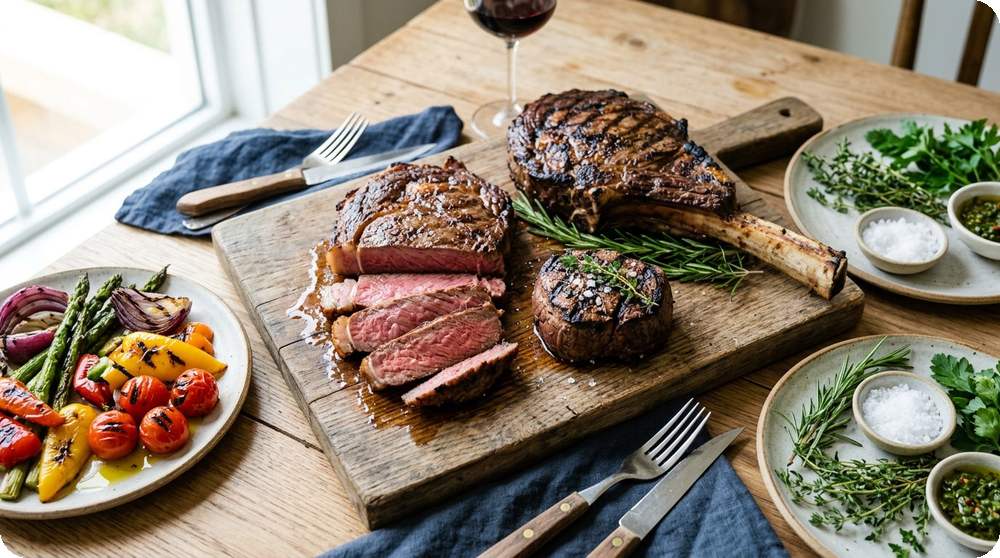
This guide focuses on choosing the cut rather than providing a full steak recipe, but a few principles are useful.
- Ribeye works well on a grill or heavy skillet.
- T-Bone suits grilling with good heat management.
- Tenderloin can be pan seared or grilled while being watched carefully.
- Strip Steak works well over direct heat.
- Thick Tomahawk steaks benefit from more controlled cooking rather than maximum heat from beginning to end.
For thick steaks, two-zone grilling or a reverse-sear approach can make the center easier to control before the exterior is finished over high heat. Professional grilling guidance also recommends using different heat zones for appropriate steak preparations.
For step-by-step cooking guidance, read Hummmy Yummmy's guide to cooking beef steak.
For food safety, USDA recommends cooking whole beef and veal steaks to a minimum internal temperature of 145°F or approximately 63°C, followed by a rest of at least three minutes.
Common Mistakes When Buying Steak
Buying a Cut Only Because It Is Famous
Tomahawk and Ribeye receive plenty of attention, but popularity does not tell you whether the cut matches your taste.
Someone who dislikes fatty steak may prefer Tenderloin even if Ribeye is the more talked-about option.
Assuming Expensive Means Better
A steak may cost more because of its size, bone, origin, breed claim, demand or processing—not because of one universal measure of superiority.
Ignoring the Cooking Method
Buying an extremely thick steak without having a way to control grill temperature can make the cooking process harder before it even begins.
Ignoring Thickness
Thickness changes the way heat reaches the center of the steak.
Not Deciding on Doneness in Advance
Know what result you want before the steak hits the cooking surface.
Overcomplicating the First Seasoning
When trying a new cut for the first time, simple seasoning can help you understand the natural flavor before experimenting with heavier marinades or sauces.
Questions to Ask Before Buying Steak
- Am I using charcoal, a grill, a skillet or an oven?
- Do I value tenderness or stronger flavor?
- Do I enjoy marbling?
- Is the steak for one person or for sharing?
- Am I comfortable cooking a thick steak?
- Do I want bone-in or boneless?
- Does presentation matter?
- Am I shopping primarily on price or experience?
- Is the steak thickness appropriate for my cooking setup?
Once you answer these questions, choosing among the many types of steak becomes much easier.
The One-Minute Steak Test
Still not sure which steak to buy?
Answer these short questions.
What Is Your Number-One Priority?
Tenderness?
Choose Tenderloin.
Rich flavor and marbling?
Choose Ribeye.
Bone-in grilling experience?
Try T-Bone.
A dramatic premium presentation?
Choose Tomahawk.
Balance between texture and flavor?
Choose Striploin.
Value for money?
Put Top Sirloin on your shortlist.
Is This Your First Steak?
Consider Ribeye, Strip Steak or Top Sirloin in a manageable, consistent thickness.
Are You Serving Several People?
A thick sharing steak such as Tomahawk can be cooked whole, rested, sliced and served at the center of the table.
Do You Prefer Less Fat?
Look toward Tenderloin or leaner Sirloin options rather than buying Ribeye only because it is famous.
Find the Steak That Matches Your Table
There is no single best steak cut for everyone.
Ribeye makes sense when rich flavor and marbling are the priority. Tenderloin wins when tenderness matters most. T-Bone serves steak lovers who enjoy bone-in cuts and varied texture. Tomahawk turns grilling and presentation into part of the occasion.
Explore the steak options available from Hummmy Yummmy, compare them according to cooking method, portion size and the eating experience you want, and choose the cut for the result—not simply for the name on the package.
Frequently Asked Questions About Types of Steak
What is the best type of steak?
There is no universal best cut. Ribeye suits people who enjoy rich flavor and marbling, Tenderloin prioritizes tenderness, T-Bone offers a bone-in experience and Tomahawk is particularly suited to large-format presentation and sharing.
What is the best steak for beginners?
Ribeye, Strip Steak and Top Sirloin can all work well for beginners when purchased in a manageable, consistent thickness. Your preference for marbling and tenderness should guide the final choice.
What is the difference between Ribeye and T-Bone?
Ribeye comes from the rib section and is known for rich marbling. T-Bone is identified by its T-shaped bone, which separates two different sections of meat and creates a more varied eating experience.
Which steak is best for grilling?
Popular rib and loin grilling cuts include Ribeye, Strip, T-Bone and Porterhouse. The right one depends on how much marbling, bone and tenderness you prefer.
Is Tomahawk steak worth the price?
It can be if you value a thick, large-format rib steak with dramatic presentation and a sharing experience. If your only priority is boneless edible meat for the money, remember that the long bone contributes to the purchased weight.
How do I recognize good steak?
Start with a clearly identified cut, appropriate and consistent thickness, intact packaging, proper storage information and a level of marbling that matches your preferences. Do not use color as the only measure of quality.
Which steak should I choose if I do not like much fat?
Tenderloin is known for tenderness without the extensive marbling associated with Ribeye. Leaner Sirloin options may also be worth considering depending on the individual product.
Why are some steaks more expensive?
Price can be influenced by cut, demand, thickness, size, bone weight, verified grade or marbling, origin, breed, feeding claims and processing. Price alone does not determine which steak will suit you best.
Is steak different from regular beef?
Steak is still beef or veal. The term generally describes particular cuts and portioning styles suited to cooking methods such as grilling, broiling and pan searing.
Should I choose Ribeye or Tenderloin?
Choose Ribeye when marbling and rich beef flavor matter most. Choose Tenderloin when softness and tenderness are the priority.