

Your meat box has arrived, but the quantity is more than you plan to cook today. What you do next matters: leaving every pack untouched, freezing everything together, and portioning the meat properly will produce very different results when you return to it later.
For practical meat storage, divide the meat into meal-size portions, keep different cuts in separate airtight packages, and label every pack with the cut and storage date. Minced meat, steaks, offal, and bone-in cuts should not all be managed as one product. Decide what will be used soon and what needs freezing before you put the order away.
Saudi Arabia's Food and Drug Authority advises keeping refrigerated meat at 5°C or below and frozen meat at -18°C, with raw meat stored in securely closed containers to prevent its juices from contaminating other foods.
What Should You Do When a Meat Order Arrives?
A single pack intended for tonight's meal requires very little planning. A mixed meat box, half carcass, family bundle, or multi-kilogram promotion is different.
Use this sequence:
- Check the order and its packaging. Identify the different meats and separate food items such as vegetables, seasoning packs, or gifts.
- Choose what you plan to cook first. Remove the amount needed for an upcoming meal before freezing the rest.
- Separate different categories. Keep minced meat, steaks, offal, bone-in cuts, and different animal types apart.
- Prepare fridge and freezer space first. A large box is much easier to organize when you already know where every group will go.
- Protect the cold chain. Do not leave a full order sitting on the kitchen counter while you deal with other groceries.
SFDA guidance warns against leaving meat outside refrigeration for more than two hours under normal conditions and recommends dividing larger amounts into smaller packages, wrapping them tightly, and removing as much air as practical before freezing.
Should Meat Go in the Fridge or Freezer?
The main question is simple: when will you use it?
Refrigeration keeps meat chilled without freezing it. Freezing is more suitable when the meat will not be used within the appropriate refrigerated storage period for that cut.
| Your plan | Practical choice |
| You will use the meat within its approved refrigerated period | Refrigerate it in a sealed container |
| You will use it later | Portion and freeze it |
| You are unsure when you will use it | Portioning and freezing prevents an open-ended stay in the fridge |
| Part is for this week and part for later | Separate fridge portions from freezer portions immediately |
SFDA sets a household refrigeration limit of 5°C or below and a freezer temperature of -18°C. The detailed FDA storage table below is based on a refrigerator at 4°C or below, which also sits within the Saudi limit.
Official Storage-Time Reference
The freezer periods below are the quality ranges listed by the U.S. FDA for the named categories when frozen at -18°C. They should not replace product-specific instructions or be extrapolated automatically to meats that are not covered by the table.
| Meat category | Refrigerator at 4°C or below | Freezer at -18°C |
| Raw ground/minced meat | 1–2 days | 3–4 months |
| Steaks | 3–5 days | 6–12 months |
| Chops | 3–5 days | 4–6 months |
| Roasts | 3–5 days | 4–12 months |
| Liver and listed variety meats | 1–2 days | 3–4 months |
Do not automatically apply these numbers to every meat sold in Saudi Arabia. Camel meat, for example, is not presented as a separate category in this FDA table. For products outside the listed categories, follow the product label, supplier instructions, or relevant official guidance rather than guessing a storage period.
How to Portion Meat Before Freezing
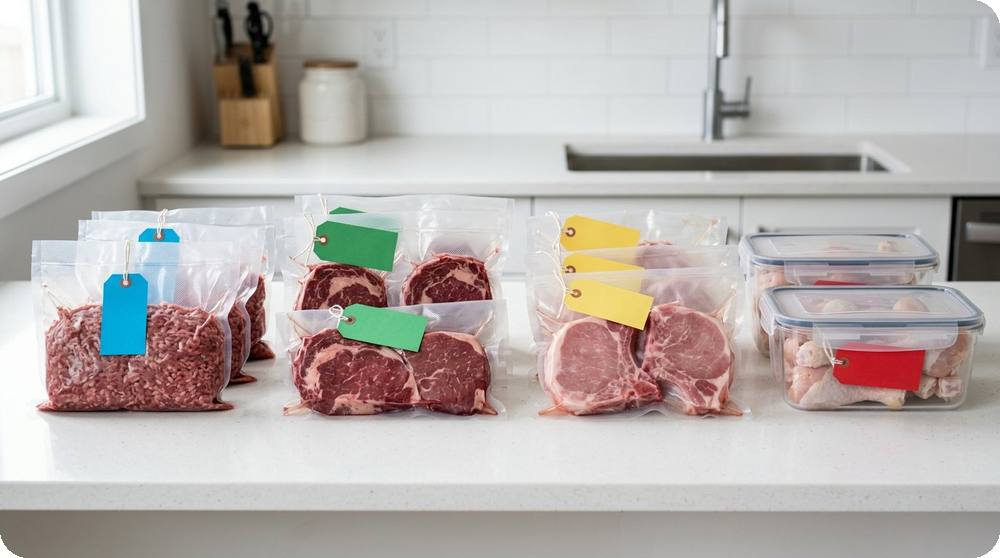
The most useful portion is not necessarily the package size delivered by the store. It is the amount you normally use in one meal.
Portion by Meal, Not Just by Package
If your household normally uses a certain amount of minced meat for pasta or kofta, package that amount together. If gatherings require larger portions, keep those packs separate from everyday portions.
The objective is simple: when you open your freezer later, you should be able to remove only what you intend to cook.
SFDA specifically recommends dividing larger quantities into several packages according to need before freezing so that the entire amount does not need to be thawed at once.
Keep Different Cuts Separate
Avoid labeling every bag simply as “meat.”
Separate:
- Minced meat.
- Steaks or sliced cuts.
- Liver and other offal.
- Shanks and bone-in cuts.
- Cuts intended for dishes such as kabsa or slow cooking.
- Lamb, beef, and camel meat when your box contains more than one type.
This is especially useful with mixed meat boxes and bundles. Instead of treating the whole order as one product, separate minced meat, steaks, bone-in cuts, and offal, then review Hummmy Yummmy meat boxes according to the actual order contents.
Label Every Pack
A useful label can be as simple as:
Cut: Minced lamb
Weight: 500 g
Stored: 17 Aug 2026
Planned use: Kofta
The label prevents you from relying on memory several weeks later when several frozen packs may look very similar.
How to Store Different Types of Meat
Minced Meat
Minced meat is one of the best reasons to portion an order before freezing.
Instead of freezing an entire kilogram together, divide it according to the quantity you normally cook at one time. Use freezer-safe bags or airtight containers and reduce excess air before sealing.
The FDA's official storage chart also gives raw minced meat a shorter refrigerated window than steaks and larger whole-muscle cuts, so it should not automatically be treated the same way.
Steaks
Separate steaks so that you can remove the number you need without thawing the full package.
Use packaging that protects the shape of the cut and limits unnecessary exposure to air. If several steaks are stacked together, food-safe separators can help prevent the entire pack from freezing into one solid block.
For readers who need help identifying cuts before assigning them to meals, Hummmy Yummmy also has a guide to beef and veal cuts.
Bone-In Cuts
Bone-in meat does not automatically receive a different storage duration simply because a bone is present; official storage tables usually categorize meat by the type of cut.
The practical difference is packaging. Sharp or projecting bone edges can put more pressure on thin bags, so choose packaging suitable for the shape of the cut and check the pack for damage before it goes into the freezer.
Liver and Other Offal
Store liver separately rather than mixing it with steaks or large cuts.
The FDA places liver and several other variety meats in a category with a shorter refrigerated period than steaks or roasts. That makes clear labeling particularly useful when deciding what to cook soon and what to freeze.
Should You Wash Meat Before Freezing It?
Do not make washing meat an automatic pre-freezing step.
Published SFDA guidance connects washing meat with the stage immediately before cooking, rather than instructing consumers to wash meat before storage or freezing. A practical application of that guidance is to keep the meat in its intended cold-storage workflow after delivery—portion, package, label, and chill or freeze it—unless the product itself carries different approved instructions.
Food-safety hygiene around the meat is still essential. Wash hands after handling raw meat, clean knives and cutting boards, and do not move directly from raw meat to ready-to-eat food with contaminated equipment. SFDA guidance emphasizes separation between raw and cooked foods and proper cleaning of utensils to prevent cross-contamination.
How Should Meat Be Wrapped for Freezing?
A large part of frozen-meat quality is determined before the freezer door closes.
Use this checklist:
- Choose freezer-safe food packaging.
- Portion the meat first.
- Reduce excess air in the pack.
- Seal the package completely.
- Do not use a torn or damaged bag.
- Protect bags from sharp bone edges.
- Write the cut and storage date on the package.
- Arrange older packs so that they are easy to use first.
SFDA recommends tight packaging and removing as much air as practical when preparing meat for freezing. FDA guidance also notes that frozen food quality can gradually decline during prolonged storage even when the product remains safely frozen at the correct temperature.
How Do You Thaw Frozen Meat Safely?
Planning the meal before you need it is usually easier than trying to rush the thawing process on the kitchen counter.
SFDA lists the refrigerator, microwave, and cold renewed/running water among approved thawing approaches, and its food-safety guidance advises against thawing food at room temperature. Refrigerator thawing is described as the safest approach.
Refrigerator-Thawing Workflow
- Remove only the portion you plan to use.
- Keep it in its package or place it inside a leak-resistant container.
- Position it low in the refrigerator and away from ready-to-eat foods.
- Allow it to thaw gradually.
- Clean any surface contacted by raw-meat juices.
- Use the meat according to the appropriate storage guidance and product instructions.
If you need a faster method, use an officially recognized approach such as cold water or microwave thawing and follow the corresponding cooking instructions.
Can You Refreeze Meat After Thawing?
It depends on how it was thawed.
SFDA states that meat and poultry thawed in the refrigerator can be refrozen. If they were thawed by other methods, the authority advises that they should preferably be cooked before being frozen again.
| Situation | Practical action |
| Thawed properly in the refrigerator | SFDA guidance permits refreezing |
| Thawed by another method | Cook before refreezing |
| You do not know how long it was outside refrigeration | Do not guess; consult official safety guidance |
| You repeatedly thaw too much | Reduce your freezer portion size |
Even when refreezing is acceptable from a safety perspective, repeated freeze-thaw cycles can reduce quality. Meal-size portions are therefore more practical than routinely relying on refreezing.
Common Meat-Storage Mistakes
Mistake: Freezing the entire order in one large bag
Better approach: divide it into meal-size portions.
Mistake: Labeling every pack “meat”
Better approach: write the meat type, cut, and date.
Mistake: Using fragile bags for bone-in cuts
Better approach: use packaging suited to the cut and inspect it after sealing.
Mistake: Thawing a kilogram of minced meat when you need only half
Better approach: divide the kilogram before freezing.
Mistake: Packing the refrigerator or freezer so tightly that cold air cannot circulate
Better approach: maintain enough space for air circulation, which official food-storage guidance identifies as important for proper cooling.
Mistake: Deciding whether meat is safe from color or smell alone
Better approach: consider storage history, temperature control, handling, dates, and official guidance. FDA warns that food can contain disease-causing microorganisms even when it does not obviously look or smell spoiled.
Practical Example: Organizing a Hummmy Yummmy Meat Box
Consider Hummmy Yummmy's current Value Fridge Meat Box.
The product page describes a mixed box with more than one meat type and cut. That variety is exactly why the box should not be treated as one freezer unit; review the actual delivered contents and portion each group by use.
That variety is exactly why the box should not be treated as one freezer unit.
Step 1: Separate the Minced Meat
Identify the type and actual quantity delivered. Divide it according to the amount your household normally uses per recipe.
Step 2: Separate the Liver
Place it in a clearly labeled pack. If it is not intended for near-term use, make a storage decision immediately rather than leaving it unidentified among the other cuts.
Step 3: Group Shanks and Other Bone-In Cuts
Package them according to their shape and intended recipe. Do not put them in the same thin bag as minced meat simply to save freezer space.
Step 4: Identify Lamb, Beef, and Camel Meat
If you use the meats for different Saudi dishes, label the animal type as well as the cut. Once frozen, relying on appearance alone can make inventory management unnecessarily difficult.
Step 5: Do Not Invent a Fixed Number of Meals
The correct number of portions depends on the actual delivered weight and your family's portion size. Without that information, saying that a box provides a fixed number of meals would be misleading.
Readers planning meals around specific beef or veal cuts can also use Hummmy Yummmy's existing guide to names of beef and veal cuts and its article on cuts suitable for boiling.
How Should Meat Be Organized in the Freezer?
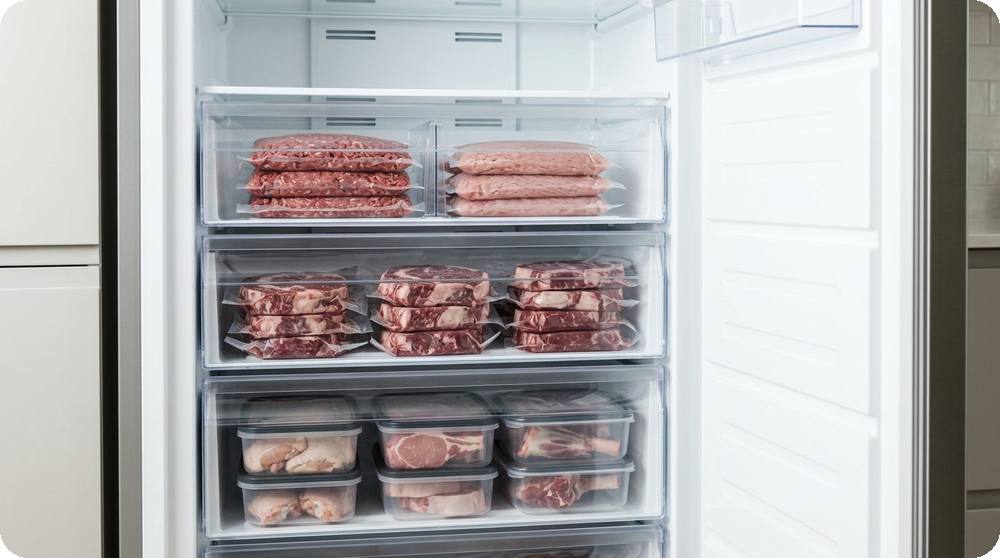
You do not need a complicated system.
A simple layout might include:
- One section for minced meat.
- One for bone-in cuts.
- One for steaks and slices.
- One for liver and offal.
- Older packages placed where they are easier to reach.
Flat minced-meat packs can also make better use of freezer space once completely frozen.
Avoid squeezing packages so tightly that they become damaged or cold-air circulation is unnecessarily restricted.
Why Can Frozen Meat Change Color?
A change in appearance does not by itself provide a complete food-safety diagnosis.
Freezing, prolonged storage, and exposure to air can affect characteristics such as color, flavor, tenderness, and juiciness. FDA also notes that food can contain pathogenic bacteria without obvious changes in appearance, smell, or taste.
Instead of judging a pack from color alone, ask:
- When was it frozen?
- Was the freezer consistently cold?
- Is the packaging intact?
- Did the meat partially thaw before?
- How was it thawed?
Storage history gives you much more useful information than a single visual cue.
Is a Large Meat Box Right for You?
Not always.
| Your situation | Better decision |
| You have freezer space and a meal plan | A larger box may be practical |
| Your freezer is already full | Choose a smaller quantity |
| You cannot portion the delivery when it arrives | A smaller order may be easier |
| You want to try only one meat type | Start with an individual product |
| You have a gathering soon | Choose according to guest count and serving style |
| You regularly use several cuts | A mixed box may simplify planning |
For example, the Super Hari Box needs freezer capacity and a portioning plan rather than being placed in the freezer as one undivided package.
If you do not have enough freezer room, are unsure how much meat your household normally uses, or prefer to test one cut first, buying less can be the more sensible option.
Frequently Asked Questions
How should minced meat be frozen?
Divide it into one-meal portions, use airtight freezer-safe packaging, reduce excess air, and label the type and date. Remember that the official refrigerated period for raw minced meat is shorter than for steaks and roasts in the FDA storage table.
Is storing steak different from storing bone-in meat?
The main practical difference is packaging and organization. Steaks benefit from being separated individually, while bone-in cuts need packaging capable of handling projecting bone edges. Do not assign storage times based only on whether a bone is present.
Can meat be thawed on the kitchen counter?
SFDA advises against thawing food at room temperature and identifies refrigerator thawing as the safest method.
Can thawed meat be refrozen?
SFDA allows refreezing when meat has been thawed in the refrigerator. Meat thawed by another method should preferably be cooked before being frozen again.
How can I tell whether stored meat is still safe?
Do not make the decision from one photograph, smell, or color change alone. Consider storage temperature, time, handling history, product instructions, and official food-safety guidance. FDA warns that pathogenic bacteria do not necessarily make food look or smell spoiled.
Store Your Meat Order in 5 Steps
- Decide what you will use soon.
- Separate minced meat, steaks, liver, bone-in cuts, and different meat types.
- Divide each group into meal-size portions.
- Seal and label every package with the cut and storage date.
- When needed, thaw only the portion you plan to cook using an officially recommended method.
A clear portioning plan at the moment the order arrives makes a large meat purchase easier to manage and reduces the need to thaw more meat than a single meal requires.
After planning your storage workflow, browse fresh meat boxes or all Hummmy Yummmy products and choose the quantity that fits your freezer space and meal plan.