
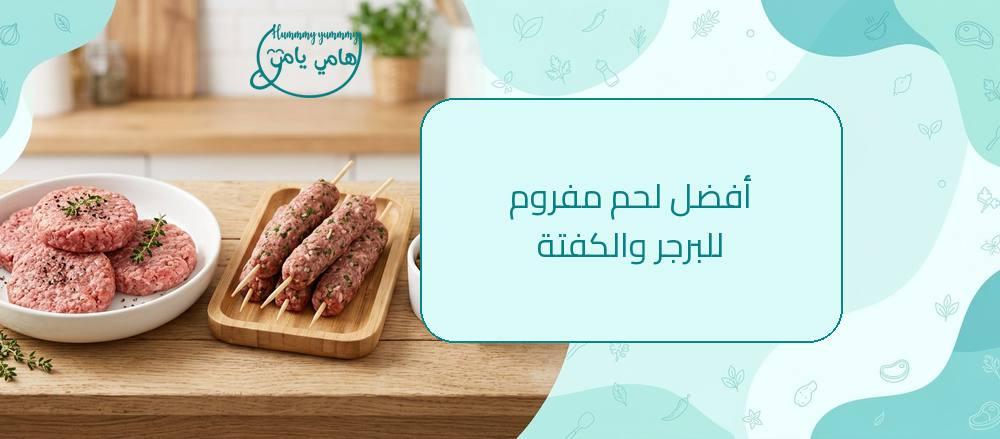
A burger patty shrinks and turns dry. Kofta breaks apart during cooking. A samosa filling releases more liquid than expected. Cooking technique may be part of the problem, but choosing the best meat for burgers or kofta starts earlier—with the meat type, fat content, grind size, and how the mince is handled.
Quick answer: There is no single minced meat that is automatically best for every recipe. Burgers need a combination of juiciness, structure, and suitable fat content, while kofta and samosa fillings require different textures. Compare lamb, beef or veal, and camel mince according to the recipe and the actual specifications of the product.
What Is the Best Minced Meat for Burgers?
If you are trying to choose the best meat for burgers, do not begin with only one question: lamb, beef, or camel?
Start with the specifications of the mince.
The animal species can affect flavor and the final eating experience, but it is only one variable. Fat content, grind size, patty formation, and cooking method can all influence the result.
Research on ground-beef patties has shown that changing fat levels can influence sensory juiciness, tenderness, and cooking yield. That makes fat content relevant, but it does not justify declaring one universal percentage ideal for every burger or every product.
Before choosing burger mince, consider four factors:
The best minced meat for burgers is therefore not defined by the animal alone. It is the mince whose specifications match the result you want.
What Determines Whether Minced Meat Works in a Recipe?
A useful buying decision separates four variables: meat type, fat content, grind size, and handling.
Meat Type
Hummmy Yummmy currently lists individual lamb, beef, and camel minced-meat products, along with a mixed pack containing separate portions of lamb, veal, and camel mince.
That does not mean one is automatically superior.
A burger has different structural requirements from samosa filling. Kofta needs different handling from meat sauce.
The better question is:
What does this recipe require the mince to do?
Fat Content
Fat content can affect more than richness.
Studies of beef patties have found relationships between fat level, sensory juiciness, tenderness, and cooking yield.
However, findings from a general study should not be presented as if they describe a specific Hummmy Yummmy product.
For a burger where fat content matters to the desired result, confirm the actual product specification first.
Grind Size
Grind size describes the size of the meat particles after grinding.
Research has shown that different grinding treatments can change texture characteristics such as hardness, springiness, and perceived particle size.
This is why the same grind should not automatically be assumed to be ideal for burgers, kofta, samosas, and sauces.
Handling
The result can also change after the meat reaches your kitchen.
Excessive mixing, strong compression during shaping, poor temperature control, or freezing a large quantity as one solid block can all make preparation less predictable.
Keep the meat chilled and divide any quantity you will not use immediately into recipe-sized portions.
Lamb vs Beef vs Camel Mince

A useful comparison should avoid claims such as “lamb is always fattier,” “beef is always more tender,” or “camel is healthier.”
Those statements require information about the actual cut, fat percentage, processing, and product specifications.
A more responsible comparison uses real product testing.
| Comparison Point | Lamb Mince | Beef/Veal Mince | Camel Mince |
| How to judge it | Test by recipe | Check specs before burgers | Try a suitable quantity first |
| Do not claim without data | Fat percentage or universal superiority | Fat percentage or exact cut source | Lower fat or healthier status |
| When to compare | Kofta, burgers, fillings | Burgers, sauces, kofta | Trial use or recipe variety |
This information matters because animal species alone does not fully predict how mince will behave.
Two beef minces, for example, can behave differently if their fat levels, meat cuts, or grind sizes are different.
The same rule applies to lamb and camel mince.
When Should You Choose Lamb Mince?
Lamb mince makes sense when its actual flavor, texture, and product specification fit the dish you are preparing.
Hummmy Yummmy offers fresh lamb mince in a 1 kg format, making it a practical option when you want to test one type or prepare a specific dish without buying several types of mince.
Instead of assuming that lamb is automatically the best mince for kofta, test it according to:
- Ease of shaping.
- Stability after cooking.
- Liquid or fat released.
- Flavor after standardized seasoning.
- Shrinkage.
- Grind size.
It may also be less suitable when the diner wants a different flavor profile or needs an exact fat specification that has not yet been confirmed.
The buying rule is straightforward: choose lamb because its tested result suits your recipe, not because the name alone suggests superiority.
When Should You Choose Beef or Veal Mince?
Ground beef is one of the first options many home cooks consider for burgers, but the same buying rules still apply.
Hummmy Yummmy offers ground beef among its mince options. Product specification, grind size, and actual fat content remain important before using it for burgers.
Product naming should remain precise.
If a store product is officially labeled “beef mince,” it should not automatically be described as veal unless the product team confirms that the terminology refers to the same product.
For burgers, verify:
- Actual fat percentage.
- Grind size.
- Patty stability.
- Weight loss during cooking.
- Texture and juiciness after standardized testing.
For everyday dishes such as meat sauces and casseroles, you may care more about how evenly the mince breaks apart and distributes through the dish than about its ability to hold a burger shape.
When Should You Choose Camel Mince?
Camel mince offers another route for customers who do not want to limit every recipe to lamb or beef.
Hummmy Yummmy offers local camel mince in a 1 kg pack. The product page currently lists uses including burgers, kebabs, casseroles, and stuffed dishes. Those uses are useful starting points, but actual performance should be verified through standardized testing rather than copied from marketing claims.
If camel mince is new to you, buying a smaller amount for a first trial is more practical than committing to a large quantity immediately.
A proper comparison should answer:
- How easily does it form a burger patty?
- How stable is it in kofta?
- How much does it shrink?
- How much cooking liquid does it release?
- How does its flavor compare when seasoning and cooking conditions are identical?
It should not be promoted as automatically “healthier” or “lower in fat” unless verified analytical data for the actual product is available.
Best Minced Meat by Recipe

A faster way to make a decision is to begin with the dish.
| Recipe | What to look for | Practical decision |
| Burger | Juiciness, structure, clear fat specification | Ask for specs or choose ready-made patties for speed |
| Kofta/kebab | Shaping and stability after seasoning | Test a limited quantity first |
| Samosa | Easy crumbling and manageable liquid | Choose mince that creates a controlled filling |
| Stuffed dishes | Even filling distribution | Focus on texture, not species name alone |
| Pasta/sauce | Consistent crumbling and distribution | One type may be enough for a daily recipe |
For Burgers
When choosing the best minced meat for burgers, look beyond the species.
Fat content matters. Grind size matters. Shaping matters.
If you do not want to control these variables yourself, ready-made burger patties may be more convenient.
For Kofta and Kebab
Kofta needs mince that can be seasoned and shaped while remaining stable through cooking.
The meaningful comparison is therefore not simply “lamb versus beef.” It is what happens to equal portions of each product under identical seasoning, shaping, and cooking conditions.
For Samosas
Samosa filling requires a different result.
The mince needs to break apart to the desired texture and work well inside a compact filling.
The internal test should therefore record how much liquid each mince releases and how easily the cooked meat distributes through the filling.
For Stuffed Vegetables and Casseroles
Here, the meat is generally combined with other ingredients.
How easily it mixes and spreads through rice, vegetables, or another filling may matter more than burger-style patty stability.
For Pasta and Sauces
Choose according to the texture you want in the sauce.
A mince that breaks apart evenly may be more useful than one selected specifically for forming patties.
Fine or Coarse Mince: Which Grind Size Is Better?
Grind size is separate from animal species and fat level.
You can have two beef minces with noticeably different particle sizes, and they may behave differently during shaping and cooking.
Research on ground beef has shown that grinding method and particle reduction can affect textural characteristics and consumer responses.
That does not mean every burger should use coarse mince or every kofta should use fine mince.
Those recommendations should be based on the actual Hummmy Yummmy products.
Useful questions before buying include:
- What grind size is currently offered?
- Is the same grind used for all meat types?
- Can customers request another grind?
- How many grinding stages are used?
- Does the grind specification change by product?
Can You Mix Two Types of Minced Meat?
Yes, different types of mince can be combined, but there is no reason to publish one “perfect ratio” without a controlled test.
Mixing can be used to alter flavor or texture, but the result depends on the actual products and proportions.
A useful internal test could compare:
- Lamb + veal/beef.
- Veal/beef + camel.
- Equal total portion weights.
- Standardized seasoning.
- Identical patty size.
- Identical cooking method.
- Weight before and after cooking.
- Structure and juiciness after cooking.
If your goal is to understand the differences between lamb, beef, and camel mince, test them separately before blending them.
Suggested Internal Test for Minced Meat
Hummmy Yummmy can later run a limited internal test comparing lamb, beef/veal, and camel mince in burgers, kofta, and samosa filling, using the same portion weight, seasoning, shaping, and cooking method. No results or rankings should be published until the test is actually performed and approved by the preparation team.
- Lamb mince.
- Beef or veal mince.
- Camel mince.
- A burger patty.
- A kofta portion.
- Samosa filling.
Use equal portions and record:
- Ease of shaping.
- Stability during cooking.
- Crumbling.
- Liquid released.
- Final texture.
Cook equal quantities and compare:
- How quickly each mince breaks apart.
- Liquid released into the pan.
- Ease of spreading through the filling.
- Texture after cooling.
Minced Meat or Ready-Made Burger Patties?
Neither is automatically better.
The decision depends on how much control you want.
| Situation | Better Fit |
| You want to control seasoning and size | Mince |
| You want to shape your own patties | Mince |
| You want faster preparation | Ready-made burger |
| You do not want to shape patties | Ready-made burger |
| You want to compare meat types | Separate mince products |
| You are preparing several dishes | Mixed mince pack |
Mince gives you more control over recipe format.
Ready-made burger patties reduce preparation steps.
That makes the “better” choice dependent on the job you want the product to perform.
One Type or a Mixed Mince Pack?
If you are making one small dish, three kilograms of different mince may be unnecessary.
If you want to prepare several recipes or directly compare meat types, a mixed pack makes more sense.
If you want to compare more than one type or prepare several recipes, review meat boxes or separate mince products rather than relying on a bundle that was not present in the sitemap snapshot. The key is to have a real use for each type and enough storage space.
| Your Situation | Decision |
| You want to compare all three types | Mixed pack is practical |
| You have one specific recipe | One type is usually enough |
| You are preparing several meals | Mixed pack may be useful |
| Freezer space is limited | Buy a smaller quantity |
| You are trying camel for the first time | Start with a limited amount |
| You want identical flavor across meals | Buy one type |
More variety is not automatically better.
Choose the pack when you genuinely have a use for three separate meat types.
How Much Minced Meat Do You Need?
There is no universal quantity that works for every family or recipe.
Ask:
- How many people are eating?
- Is mince the main ingredient or part of a filling?
- Does the dish contain rice, vegetables, pasta, or other substantial ingredients?
- Are you preparing one meal or several?
A burger meal and samosa filling should not be calculated in the same way.
For that reason, a fixed serving size should not be invented without recipe testing.
How Should You Portion and Store Minced Meat?
If you buy several kilograms, portioning should begin before the day you cook.
- Decide which recipe each pack or portion will be used for.
- Divide the mince into meal-sized quantities.
- Label each pack with meat type and storage date.
- Store portions separately.
- Avoid freezing several kilograms as one block unless you plan to use all of it together.
The Saudi Food and Drug Authority advises keeping meat refrigerated at 5°C or below and frozen at -18°C or below.
As a general cold-storage reference, the U.S. government's FoodSafety.gov chart lists raw hamburger and ground meats at 1–2 days refrigerated and 3–4 months frozen. Always follow the product's use-by date and packaging instructions when they are more restrictive.
What Internal Temperature Should Ground Meat Reach?
Do not rely on color alone to determine whether minced meat is fully cooked.
Saudi Food and Drug Authority guidance lists ground beef, veal, and lamb at 71°C. Use a food thermometer to check the inside rather than relying on color alone.
A food thermometer provides a more reliable check than visual appearance alone.
Common Mistakes When Buying Minced Meat
Choosing the meat before choosing the recipe
Better decision: decide whether you are making burgers, kofta, samosas, or sauce first.
Ignoring fat specifications
Better decision: ask for the actual fat content when it materially affects the result you want.
Assuming one grind size is ideal for everything
Better decision: treat meat species and grind size as separate variables.
Buying a large quantity for a first test
Better decision: try a limited amount before committing to a larger pack.
Overworking burger meat
Better decision: handle the mince only as much as needed to form a stable patty.
Freezing the entire quantity together
Better decision: portion mince according to future meals before freezing.
Judging quality by color alone
Better decision: also consider packaging condition, storage, smell, labeling, and use-by date.
Expecting lamb, beef, and camel to perform identically
Better decision: compare them under the same recipe and cooking conditions.
Relying on marketing descriptions instead of specifications
Better decision: ask for fat content, grind size, and other relevant product information when precision matters.
Frequently Asked Questions
What is the best meat for burgers?
There is no universal winner. Choose mince with a known fat specification and grind size that delivers the juiciness and structure you want.
Is lamb mince good for burgers?
Lamb mince can be used for burgers, but whether it is the best choice depends on the actual product specification and test result.
What is the best mince for kofta?
Can camel mince be used for kofta?
Yes, but its actual stability, texture, and cooking behavior should be tested before describing it as the preferred choice.
Is fat content important in burgers?
Yes. Research indicates that fat level can influence juiciness, texture, and cooking yield in beef patties, but one ideal percentage should not be prescribed without considering the specific product and recipe.
Can two types of mince be mixed?
Yes. However, test the individual products first and avoid presenting an untested mixing ratio as ideal.
Should I buy mince or ready-made burgers?
Choose mince if you want control over size, seasoning, and shaping. Choose ready-made burgers when quicker preparation is the priority.
Choose Your Minced Meat in Four Steps
1. Start with the recipe.
Burger, kofta, samosa, stuffed vegetables, or pasta sauce?
2. Check the specifications.
What meat type is it? What is the actual fat content? What grind size is used?
3. Buy the quantity that matches your meals.
Do not buy three kilograms simply to prepare one small recipe.
4. Test before buying in bulk.
Compare shaping, stability, cooking loss, juiciness, and final texture—then choose the mince that actually works for the way you cook.
Start with the recipe, then compare lamb mince, ground beef, and camel mince, or review meat boxes if you are planning several meals.